The CMS shouldn’t be the first website decision.
Yet it often is.
- “We’re a WordPress company.”
- “We want headless.”
- “Our last website used X, so this one should too.”
Technology becomes the starting constraint before anyone has defined what the website actually needs to do.
We prefer the opposite direction.
Start with requirements
Before selecting a CMS, understand:
- Who will manage the content?
- How often will it change?
- What kinds of content relationships exist?
- What integrations are required?
- How important are preview workflows?
- Does the website need application-like functionality?
- What does the internal team already know?
- What level of maintenance is appropriate?
Those questions narrow the technology choices naturally.
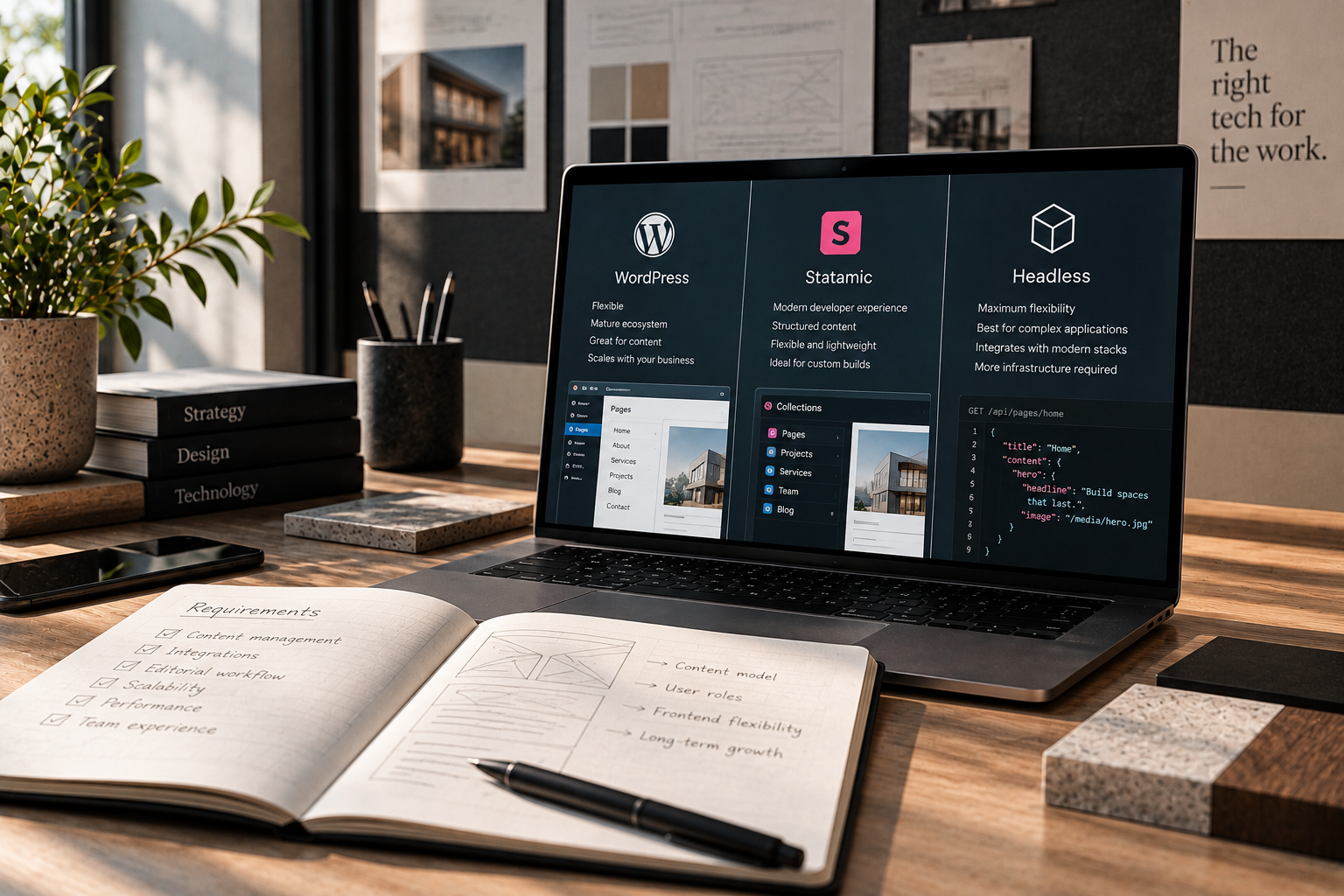
WordPress can be an excellent choice
WordPress makes sense for many content-driven business websites.
It has a mature ecosystem, familiar editorial workflows and enormous flexibility.
Used thoughtfully, it can support highly custom digital experiences without forcing the front end to resemble a theme.
Our own approach to WordPress is straightforward:
The CMS should manage content without being allowed to redesign the website.
Statamic solves a different set of problems
Statamic can be compelling when teams want a modern developer experience, structured content and a flexible CMS without relying on a traditional database-driven WordPress architecture.
It isn’t “better WordPress.”
It’s another tool with different tradeoffs.
Headless isn’t automatically more modern
Separating the CMS from the front end can be powerful.
It can also introduce additional infrastructure, deployment complexity, preview challenges and maintenance requirements.
Those tradeoffs make sense when the project benefits from them.
They make much less sense when “headless” is simply being used as a synonym for modern.
Technology should follow the work
We work across WordPress, Statamic and modern application frameworks because different problems deserve different foundations.
That philosophy extends beyond websites into our Custom Web Applications work as well.
The question isn’t:
“Which CMS is best?”
It’s:
Which architecture best supports this organization, this team and this experience?
Choose that. Then let the technology disappear behind the work