Accessibility shouldn’t be something a team remembers during QA.
By then, many of the decisions that determine accessibility have already been made.
- Color.
- Typography.
- Navigation.
- Content hierarchy.
- Forms.
- Interactions.
- Motion.
- Markup.
Accessibility lives throughout the experience.
It starts in design
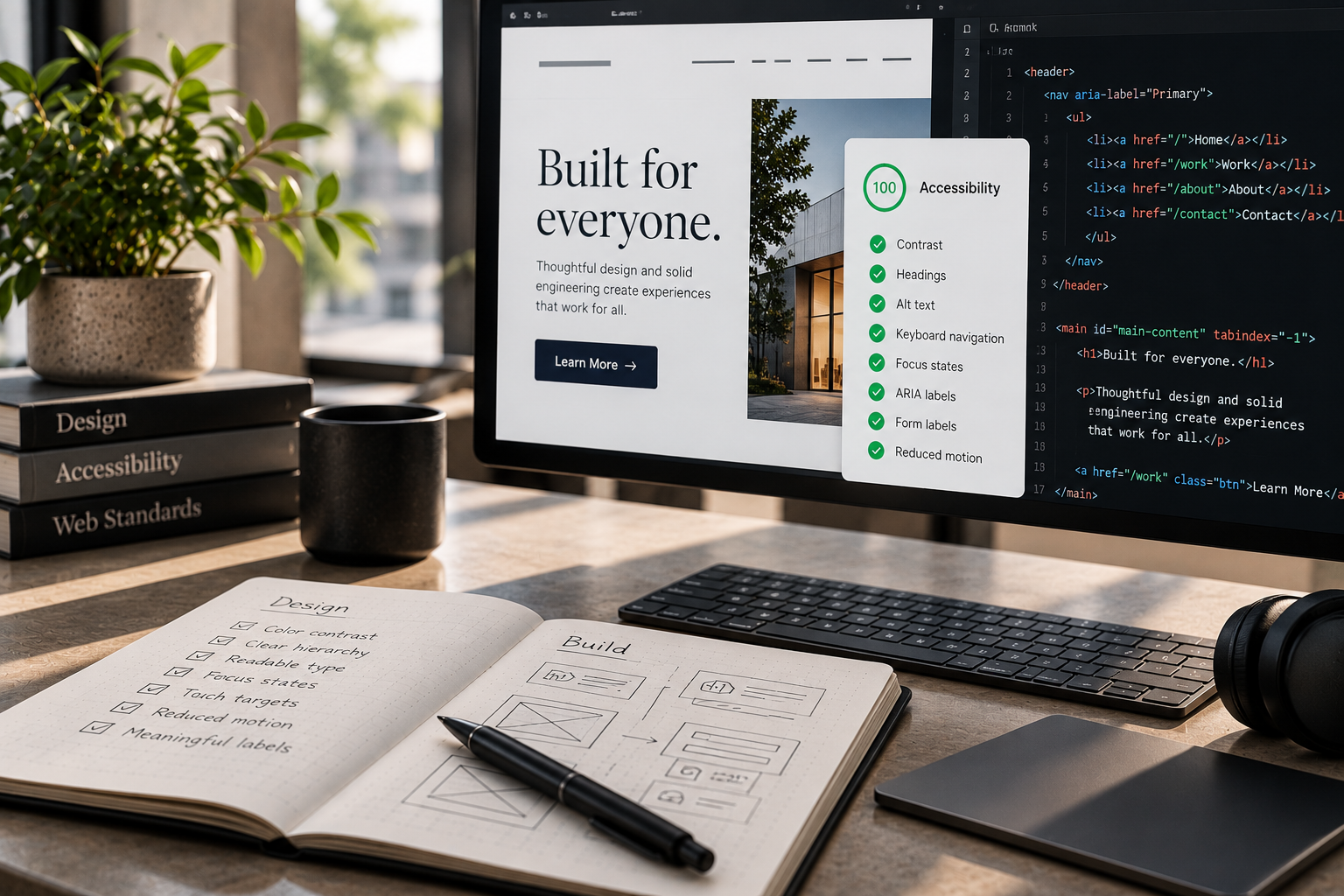
- Contrast matters before development.
- Focus states need consideration before components are finalized.
- Information shouldn’t depend entirely on color.
- Interactive controls need sufficient size and clear states.
- Motion should respect people who prefer reduced movement.
These are design decisions.
Content matters too
- Clear headings create structure.
- Descriptive links provide context.
- Alternative text gives meaning to relevant images.
- Plain, understandable language helps more people navigate information.
Accessibility isn’t exclusively an engineering responsibility.
Then engineering preserves the intent
- Semantic HTML gives content meaning.
- Keyboard navigation needs to work.
- Forms require appropriate labels and feedback.
- Interactive components need meaningful states.
- Focus needs to move predictably.
Engineering turns accessible intentions into accessible behavior.
Test throughout the work
Automated tools are useful, but they aren’t enough.
- Keyboard testing matters.
- Screen-reader testing matters.
- Human judgment matters.
Accessibility isn’t a number produced by an audit tool.
It’s whether people can actually use the experience.
Build it in
Treating accessibility as remediation makes it expensive and incomplete.
Treating it as a project constraint makes it part of the quality of the work.
That’s how we approach engineering within our Custom Website Design & Development projects.
Accessibility isn’t something added to good work. It’s one of the things that makes the work good