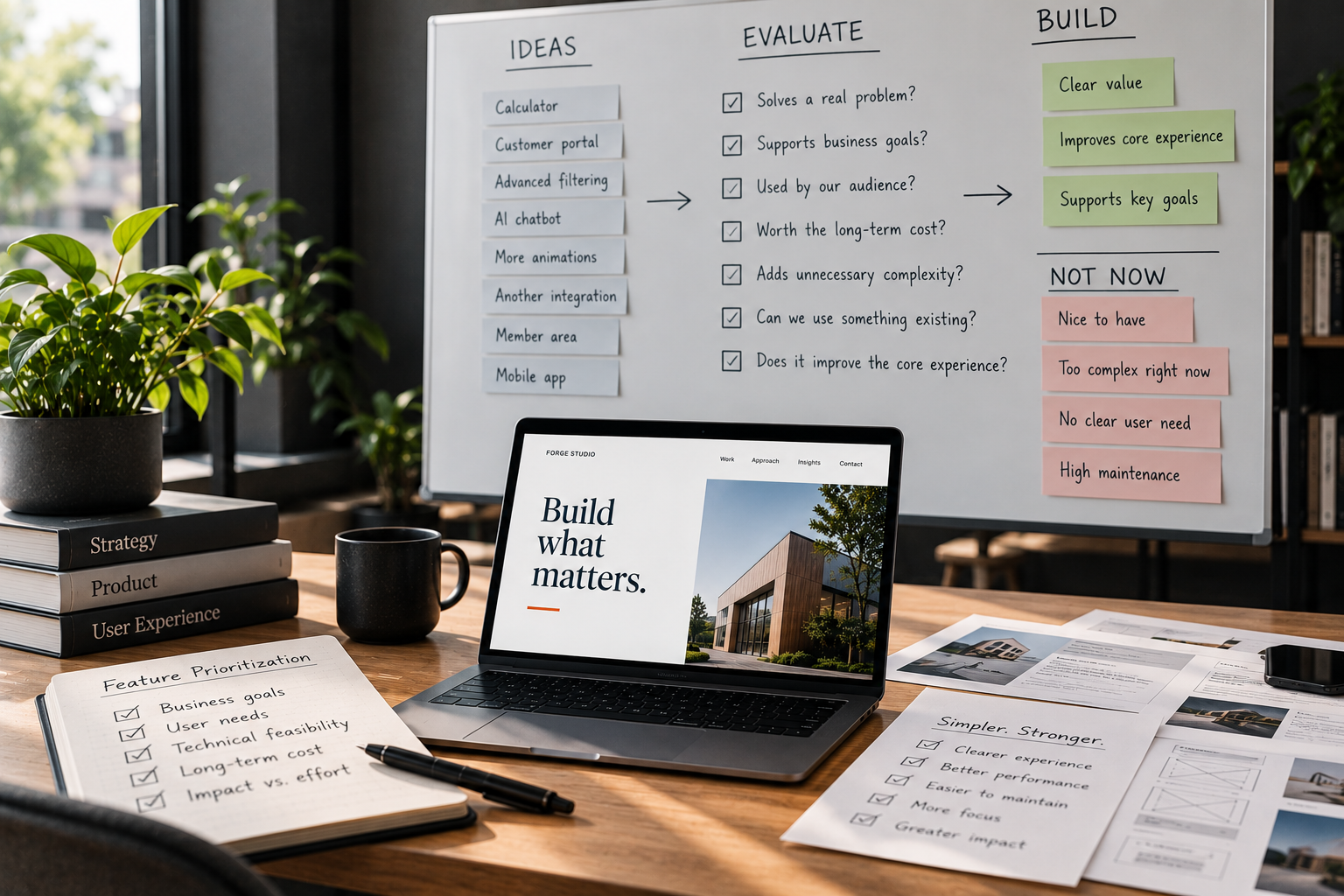
Digital projects naturally accumulate ideas.
- Could we add a calculator?
- What about a portal?
- Could this animate?
- Should we build filtering?
- Can we integrate another platform?
- Could AI handle this?
Most of those things are possible.
That’s not the same as saying they’re worth building.
Possibility isn’t a requirement
Technology makes it easy to confuse can with should.
A feature earns its place when it solves a meaningful problem for the business or its users.
Otherwise it creates complexity.
- More interface.
- More development.
- More testing.
- More maintenance.
- More opportunities for something to break.
Every feature has a long-term cost
The cost of a feature isn’t just what it takes to launch.
- Someone has to maintain it.
- Content may need updating.
- Dependencies change.
- APIs evolve.
- Users need support.
- Design systems need to accommodate it.
Technical decisions accumulate.
That doesn’t mean avoiding complexity.
It means spending complexity deliberately.
Start with the outcome
Instead of asking:
“What could we add?”
Ask:
What needs to become easier, clearer or more effective?
Sometimes the answer requires sophisticated functionality.
That’s exactly where Custom Web Applications can make sense.
Other times the answer is better content, clearer architecture or a simpler workflow.
Restraint creates room
Removing unnecessary features gives important things more space.
- The primary action becomes clearer.
- The interface becomes easier to understand.
- Development can focus on quality.
- Performance improves.
- Maintenance becomes more manageable.
The result often feels more sophisticated precisely because it does less.
Good partners should sometimes say no
A digital partner shouldn’t measure value by how much they can sell into a project.
Sometimes the most valuable recommendation is:
Don’t build that yet.
- Validate the need.
- Simplify the idea.
- Use something that already exists.
- Or leave it out entirely.
That’s part of what we mean when we say Forge Studio builds around the business.
- Not around a list of features.
- Not around a preferred technology.
- Not around how much complexity we can introduce.
The goal isn’t to build more. It’s to build what matters